


The 5 stages of educational development provide a clear framework for understanding how children acquire skills and knowledge over time. Each stage is crucial in shaping a child’s cognitive, emotional, and social growth. From early childhood to adolescence, children move through distinct phases that build upon one another. As they progress, these stages help develop foundational skills like reading and writing, while also fostering critical thinking and problem-solving abilities. Understanding “the 5 stages of educational development” is essential for parents, educators, and caregivers, as it ensures that children receive the right support during each learning journey.
What Is Educational Development?
Educational development refers to the systematic progression of skills and knowledge acquisition in children. It encompasses everything from basic motor skills in infancy to complex problem-solving abilities in adolescence. As children grow, their cognitive, social, and emotional skills evolve, shaping their learning experience. For instance, early childhood focuses on foundational skills like language and coordination, while later stages emphasize abstract thinking and reasoning. Moreover, this development forms the backbone of a child’s education, guiding them through each stage of learning. Ultimately, understanding educational development helps parents and educators better support a child’s growth and success. As educational expert Jean Piaget stated, “The principal goal of education is to create men who are capable of doing new things, not simply of repeating what other generations have done.”
Now, let’s explore the 5 stages of educational development highlighting how each one contributes to a child’s overall learning process.
The 5 Stages of Educational Development
The 5 stages of educational development offer a clear roadmap for understanding how children progress academically. For instance, the early stages focus on building foundational skills like reading and writing. As children advance, they develop more complex abilities such as critical thinking and problem-solving. Moreover, recognizing the 5 stages of educational development allows educators to adapt their teaching methods to support individual growth. Ultimately, understanding The 5 Stages of Educational Development ensures that both parents and teachers can guide children’s learning effectively at every step.
Here’s a more comprehensive description of the 5 stages of educational development:
Early Childhood Education (Birth to Age 5)

Early childhood education (ECE) focuses on children from birth to around age 5, covering preschool and early years. This stage is crucial for developing foundational skills in language, social-emotional understanding, cognitive abilities, and basic motor skills. Through structured play, interactive activities, and guided learning, children learn to explore their environment, form relationships, and build a love for learning. Quality ECE sets the stage for future academic success by encouraging creativity, curiosity, and problem-solving abilities.
- Focus Areas: Developing communication, emotional regulation, motor skills, creativity, problem-solving, and the ability to interact with others.
- Learning Methods: Play-based learning, hands-on activities, storytelling, songs, and games are used to engage children and support their natural curiosity.
- Key Milestones: Mastery of basic language, development of fine and gross motor skills (e.g., running, holding a pencil), beginning to recognize letters and numbers, and learning social rules like taking turns.
- Significance: A quality ECE program provides a strong foundation for future learning by creating a supportive environment that nurtures children’s natural curiosity and builds essential cognitive and social skills.
Elementary Education (Ages 6 to 12)

Elementary education typically covers children from ages 6 to 12 (grades 1 through 6). This stage builds on the skills developed during early childhood and introduces formal subjects like reading, writing, mathematics, science, and social studies. Children develop core academic skills, critical thinking, and basic knowledge, which are essential for more complex learning. Elementary education also emphasizes social development, cooperation, and emotional regulation, as children learn to work in groups, follow routines, and handle responsibilities.
- Focus Areas: Basic literacy and numeracy skills, introduction to scientific concepts, history, and geography, and development of problem-solving and critical thinking skills.
- Learning Methods: Formal instruction in classrooms, project-based learning, hands-on experiments, group work, and creative activities to engage students in various subjects.
- Key Milestones: Learning to read and write proficiently, understanding mathematical concepts like addition and multiplication, developing the ability to work independently, and starting to form a sense of responsibility and self-discipline.
- Significance: Elementary education builds the essential skills that children will need in later stages. It’s also a critical period for social and emotional growth, where children learn about teamwork, communication, and personal responsibility.
Secondary Education (Ages 12 to 18)

Secondary education generally includes students from ages 12 to 18 (middle school and high school). This stage focuses on deepening academic knowledge in specific subject areas such as math, science, language arts, and history, along with elective courses. Students develop analytical and critical thinking skills while preparing for higher education or vocational training. Socially, this stage is vital for self-discovery, peer interactions, and identity formation. Secondary education often includes career preparation and personal development, helping students make decisions about their future paths.
- Focus Areas: Deepening academic knowledge, and critical thinking, developing specific skills for higher education or vocational paths, and gaining a broader understanding of society and culture.
- Learning Methods: Classroom instruction, independent research, group projects, and extracurricular activities that foster personal interests and talents.
- Key Milestones: Mastery of more advanced academic subjects, development of personal interests and career aspirations, participation in social and extracurricular activities, and beginning to make more independent life choices.
- Significance: Secondary education is vital for preparing students for either higher education or the workforce. It helps shape their future career paths, teaches essential life skills, and fosters independence and responsibility.
Post-Secondary or Higher Education (Ages 18 and Up
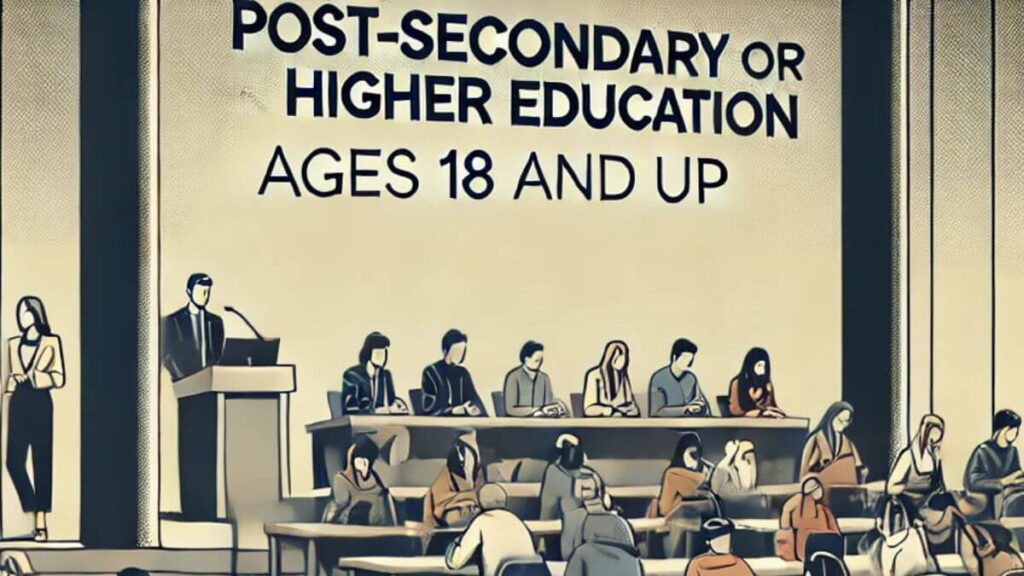
Post-secondary education refers to learning that takes place after high school, including college, university, vocational training, and other forms of advanced education. In this stage, students focus on specialized knowledge and skills in their chosen fields. Critical thinking, problem-solving, and advanced learning techniques are emphasized to prepare individuals for professional careers or further academic pursuits. Post-secondary education is often a time of independence, self-directed learning, and the transition to adulthood and professional life.
- Focus Areas: Specialization in areas of interest or career fields, research, advanced study, developing professional skills, and gaining practical experience through internships or work placements.
- Learning Methods: Lectures, seminars, labs, research projects, and hands-on training tailored to specific careers or academic disciplines.
- Key Milestones: Earning a degree or certification, mastering specialized skills, gaining practical experience, and transitioning from student life to professional life.
- Significance: Higher education opens doors to career opportunities, personal growth, and intellectual development. It also plays a key role in the global economy by preparing individuals with specialized knowledge and skills needed in various industries.
Lifelong Learning (Ongoing)

Lifelong learning refers to the continuous pursuit of knowledge and skills throughout an individual’s life. It can take place in both formal and informal settings, such as professional development, online courses, personal interest classes, and self-directed learning. Lifelong learning helps individuals stay updated in their careers, adapt to changing environments, and maintain intellectual curiosity. This stage is increasingly important in a fast-evolving world where skills and knowledge need constant renewal, ensuring personal growth and adaptability in various aspects of life.
- Focus Areas: Continuous personal or professional development, staying updated with new knowledge and skills, adapting to changes in the workplace or personal interests, and maintaining intellectual curiosity.
- Learning Methods: Self-directed learning, online platforms, professional certifications, adult education classes, reading, attending seminars or workshops, and learning from everyday experiences.
- Key Milestones: Acquiring new skills or certifications, changing careers, learning a new hobby or interest, staying intellectually engaged, and adapting to changing environments or job markets.
- Significance: Lifelong learning helps individuals stay relevant in an evolving world, adapt to changes in technology and industry, and continuously grow both personally and professionally. It promotes resilience, flexibility, and a growth mindset that is essential in today’s rapidly changing society.
Each stage of educational development plays a unique role in shaping individuals for success in various aspects of life, from early cognitive and social skills to advanced professional knowledge and continuous personal growth.
Factors That Influence Educational Development
Educational development is shaped by various factors, such as a child’s environment, the quality of their education, and their socio-economic background. Here are some key influences:
Home Environment
A nurturing home environment significantly influences a child’s educational development. For instance, children who have access to educational materials like books and puzzles often gain an academic advantage. Additionally, a supportive atmosphere that encourages curiosity and learning fosters cognitive growth. Furthermore, regular parent-child interactions, such as reading together, help strengthen language skills and comprehension. Consequently, a positive home environment sets the foundation for future academic success.
Quality of Education
High-quality early childhood education is essential for laying the foundation for future academic success. Schools that offer supportive teachers, well-structured curricula, and adequate resources provide children with greater growth opportunities. Moreover, when students receive guidance from skilled educators, their cognitive and social development is significantly enhanced. Additionally, a strong educational framework fosters a love for learning, which continues to benefit students as they advance through their academic journey.
Socio-economic Status
Socioeconomic status plays a major role in a child’s educational development. Children from low-income families often face more challenges due to limited access to resources such as books, technology, and tutoring. However, providing equitable educational opportunities is key to bridging the achievement gap. Additionally, when schools and communities offer extra support, these children are better positioned to succeed. Ultimately, addressing socioeconomic disparities can help ensure that all students thrive academically.
Why Understanding These Stages Matters
Understanding The 5 Stages of Educational Development is essential because it helps parents, educators, and professionals provide the right support at the right time. As children progress through these stages, their learning needs and abilities change. For example, in early childhood, the focus is on building foundational skills such as language and motor development. However, as they advance, children require more guidance in critical thinking and problem-solving. Moreover, knowing where a child is within The 5 Stages of Educational Development allows for tailored teaching methods that address their unique challenges. This not only enhances academic success but also promotes confidence and a positive attitude toward learning. Ultimately, recognizing these stages ensures that children receive the support they need to thrive at every phase, fostering both intellectual and emotional growth. By understanding The 5 Stages of Educational Development, parents and educators can guide children toward a successful and fulfilling educational journey.
Practical Tips for Parents and Educators
For Parents:
For parents, engaging children in age-appropriate activities is vital for stimulating both cognitive and motor skills. Moreover, offering consistent emotional support fosters a love for learning. By creating a nurturing environment that encourages exploration and curiosity, parents can significantly enhance their child’s overall development and educational journey.
For Educators:
For educators, offering a balanced curriculum that addresses the diverse needs of learners at every developmental stage is essential. Additionally, incorporating creative activities fosters critical thinking and problem-solving skills. By engaging students in varied learning experiences, educators can support both cognitive growth and emotional development effectively.
For Healthcare Professionals:
For healthcare professionals, regularly monitoring both physical and cognitive development is crucial. This ensures that children are progressing appropriately with their educational milestones. Additionally, early identification of any developmental delays allows for timely interventions. By collaborating with parents and educators, healthcare professionals can support a child’s overall growth and learning.
For Policymakers:
For policymakers, advocating for equal access to quality education is vital. Prioritizing children across socio-economic backgrounds helps reduce educational disparities. Additionally, investing in early childhood education programs yields long-term benefits, supporting individual growth and strengthening society, ultimately contributing to a more equitable and prosperous future for all.
In conclusion, understanding the 5 Stages of Educational Development empowers caregivers and educators to provide targeted support. Identifying a child’s stage allows for tailored teaching methods. Creating an encouraging environment helps children thrive academically. This approach boosts immediate progress and lays the foundation for future success and curiosity.
Each educational stage builds upon the previous, promoting intellectual, social, emotional, and cognitive growth. From foundational skills in early education to specialization and lifelong learning, each phase supports adaptability and growth.
Students face unique challenges at each stage. Young children often experience separation anxiety. School-age kids may struggle with learning difficulties or peer pressure. Post-secondary students deal with academic stress. Lifelong learners must balance education with other responsibilities.
Parents and educators support students by providing age-appropriate guidance and nurturing curiosity. Early stages need a supportive environment, while later stages thrive with encouragement toward independence, critical thinking, and open, active communication.
