

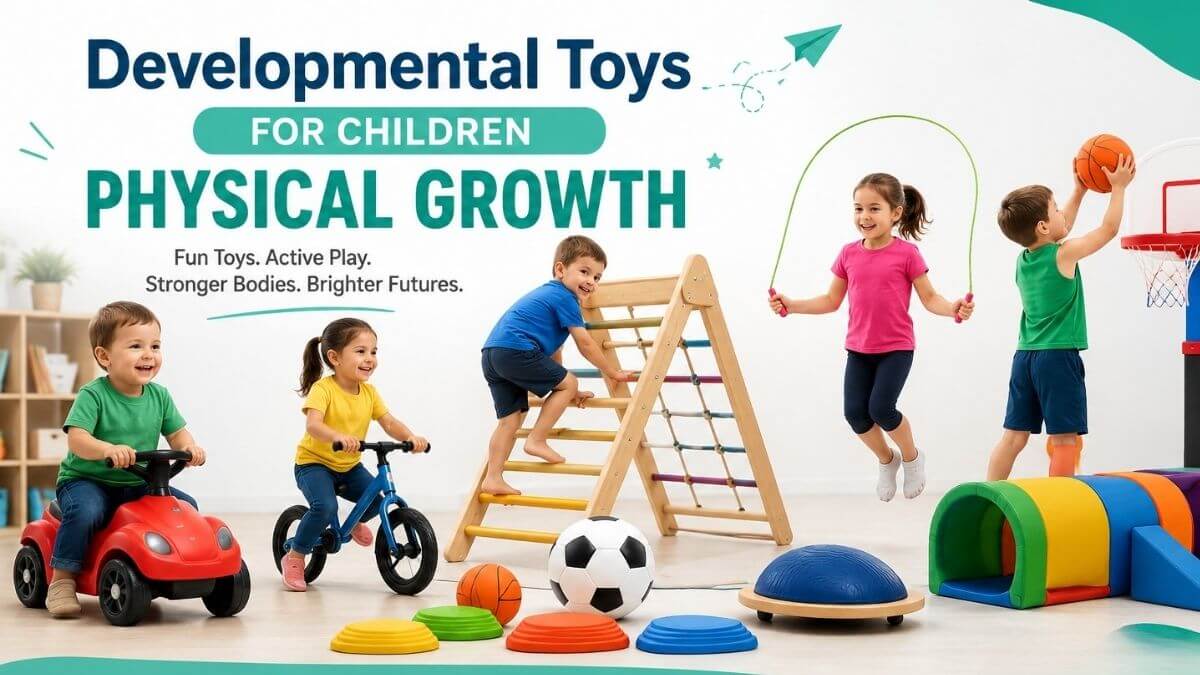
Developmental Toys play a vital role for Children Physical Growth in building strength, balance, coordination, and motor skills from an early age. Physical growth is not limited to height or weight. It also includes how well the body moves, controls muscles, and maintains stability. The right toys encourage active play, which helps children develop strong muscles and better body control. Toys such as ride-on toys, climbing sets, balls, and balance tools invite movement in a fun and engaging way. As children push, pull, jump, and balance, their bodies grow stronger and more coordinated.
In addition, Developmental Toys support not only Physical Growth but also sensory development and confidence in children. When children interact with toys that require movement, the brain learns how to guide the body safely and effectively. This improves spatial awareness and coordination over time. Active play also builds self-confidence, as children feel proud when they master new movements. With regular play, endurance improves and healthy physical habits begin to form. Choosing the right developmental toys turns everyday play into a powerful tool for physical growth and overall well-being.
Why Developmental Toys Matter for Physical Growth
Developmental Toys is very mportant to build strength, balance, and coordination for Children Physical Growth. Moreover, Developmental toys encourage children to move, stretch, climb, jump, and practice different motor skills that’s help child for their proper Physical growth .As a result, regular movement can support muscle development, body control, and physical confidence. Furthermore, age-appropriate toys help improve both gross and fine motor skills while making physical activity enjoyable. Therefore, Developmental toys can support healthy physical growth through fun, purposeful, and engaging play.
Developmental toys plays a powerful role in children physical growth, especially during early childhood. When children move, stretch, push, pull, and balance, the body grows stronger and more coordinated. Developmental toys are designed to encourage this kind of movement in a natural and enjoyable way for children Physical growth . Through play, gross motor skills develop as large muscles in the arms, legs, and core work together during actions such as walking, climbing, jumping, and riding. At the same time, fine motor skills improve when small muscles in the hands and fingers are used to grasp, stack, squeeze, or build. Toys like balls, ride-on toys, blocks, and climbing sets invite repeated movement, which helps muscles gain strength and endurance. Because play feels fun rather than forced, children stay active longer and move with confidence.
In addition, developmental toys support balance, coordination, and spatial awareness, which are essential for everyday activities and future learning. Balancing on stepping stones, catching a ball, or navigating an obstacle course helps the body learn control and stability. These experiences teach children how to judge distance, understand body position, and move safely in their environment. As physical skills improve, confidence grows. A confident child is more willing to try new movements, explore new challenges, and stay physically active. Over time, this confidence supports independence, focus, and social interaction. Well-chosen toys turn movement into meaningful play, helping physical development grow alongside emotional and cognitive skills. When children are given the right tools to move, explore, and play freely, a strong foundation for lifelong health and learning is created.
Active play fuels physical development. Through play, children build:
✔ Gross motor skills :large muscle movement like walking and jumping
✔ Fine motor skills :precise hand and finger movements
✔ Spatial awareness :All of these support confidence and future learning
Top Developmental Toys for Physical Growth
Ride-On Toys & Push Cars
Ride-on toys and push cars play an important role in early physical development. These toys encourage children to use their leg muscles to move forward, stop, and change direction. As toddlers push with their feet or steer the handle, the lower body becomes stronger and more controlled. At the same time, the upper body works to maintain posture and grip, which improves overall coordination. Because movement is self-directed, children naturally learn how to control speed and balance. This builds confidence in walking and supports the transition from assisted movement to independent mobility.
In addition, ride-on toys help improve endurance through repeated motion. As children ride for longer periods, muscles adapt and become stronger. Steering and navigating around objects also improve spatial awareness and body control. These toys are especially helpful for early walkers because they provide gentle support while encouraging active movement. With regular use, ride-on toys turn everyday play into an effective way to strengthen legs, improve balance, and support healthy physical growth.
Benefits:
✔ Builds leg strength
✔ Enhances balance
✔ Supports coordination
Balance Bikes
Balance bikes are ideal for preschool-aged children. They help children learn balance before using pedals. By pushing off the ground with their feet, children learn how to control their body weight. This strengthens core muscles and improves stability. Steering the bike also improves coordination and focus.
Pediatrician Dr. Laura Jana explains, “Balance is a foundational skill that supports all physical activities, from walking to sports.” Balance bikes help build this skill naturally. As children gain confidence, they glide longer and move more smoothly. This boosts self-esteem and independence. Balance bikes also make the transition to pedal bikes easier later. With simple movement and repeated practice, balance bikes support healthy physical growth in a gentle and enjoyable way.
Benefits:
✔ Core strength development
✔ Improved balance
✔ Confidence in mobility
Climbing Structures & Indoor Gyms
Climbing structures and indoor gyms invite children to crawl, climb, and explore safely. These activities strengthen arms, legs, and core muscles while improving flexibility. Moving in multiple directions also develops coordination, balance, and spatial awareness. Children learn to judge distances and adjust movements, which enhances motor skills.
Child development expert Dr. Stuart Brown explains, “Movement-based play helps children develop both physical strength and problem-solving skills.” Navigating climbing structures also challenges children to plan their actions, improving cognitive skills alongside physical growth. Indoor gyms provide a safe and stimulating environment for active play.
Benefits:
✔ Builds upper-body and core strength
✔ Enhances coordination and balance
✔ Encourages problem-solving through movement
Jump Ropes
Jump ropes are simple but highly effective for physical development. Skipping improves leg and core strength while increasing cardiovascular fitness. It also develops timing, rhythm, and hand-eye coordination as children coordinate jumps with rope swings. Adjustable ropes grow with the child, providing a long-term play option.
Fitness expert Dr. Len Kravitz notes, “Jumping activities help improve heart health, coordination, and muscular strength.” Jump ropes support full-body movement and endurance. The repetitive action of jumping builds strength and stamina while making exercise fun. Children also develop focus and control during practice.
Benefits:
✔ Improves cardiovascular endurance
✔ Enhances rhythm and timing
✔ Strengthens full-body coordination
Balls of All Sizes
Balls are versatile tools that support multiple aspects of physical growth. Rolling, throwing, catching, kicking, and bouncing strengthen arms, legs, and core muscles. These movements improve hand-eye coordination and spatial awareness. Soft balls are perfect for toddlers, while larger balls challenge older children.
Pediatric occupational therapist Dr. Cara Koscinski says, “Ball play helps children develop coordination, strength, and social interaction skills.” Playing with balls also encourages sharing, turn-taking, and teamwork. Regular ball activities improve strength, endurance, and confidence in movement.
Benefits:
✔ Develops hand-eye coordination
✔ Strengthens upper and lower body
✔ Encourages social play and teamwork
Foam Stepping Stones
Foam stepping stones create fun paths for hopping, jumping, and balancing. They strengthen leg muscles and improve core stability. Navigating between stones challenges balance and coordination, making children more confident movers. The bright colors and textures also engage sensory skills.
According to child development experts, stepping and balancing activities teach spatial awareness and body control. Foam stepping stones are safe for toddlers and preschoolers and can be used indoors or outdoors. They turn simple movement into engaging play that supports child’s healthy physical growth.
Benefits:
✔ Improves balance and stability
✔ Strengthens legs and core muscles
✔ Enhances coordination and spatial awareness
Adjustable Basketball Hoop
An adjustable basketball hoop encourages running, jumping, aiming, and shooting. These movements strengthen arm, leg, and core muscles while improving coordination. Adjusting the hoop height makes it suitable for different ages and skill levels, keeping children motivated to practice.
Child development expert Dr. Laura Jana explains, “Sports and active games help children develop strength, coordination, and confidence in their movements.” Playing basketball also teaches turn-taking, teamwork, and patience. Regular use boosts endurance, balance, and spatial awareness while making exercise fun.
Benefits:
✔ Builds arm, leg, and core strength
✔ Improves coordination and timing
✔ Encourages teamwork and social skills
Balance Boards
Balance boards and beginner yoga sets help children develop core strength and stability. Standing, bending, or shifting weight on the board challenges the body to maintain control. This improves posture, balance, and overall body awareness. These toys also encourage mindful, slow, and controlled movements.
Fitness expert Dr. Len Kravitz notes, “Balance activities help children develop core strength, stability, and focus.” Practicing on balance boards enhances coordination and confidence. Children learn how to adjust their bodies safely while improving concentration and control.
Benefits:
✔ Enhances core stability and balance
✔ Improves posture and body control
✔ Encourages focus and controlled movement
Slide & Ladder Sets
Slide and ladder sets combine climbing and sliding for full-body exercise. Climbing strengthens legs, arms, and the core, while sliding improves balance and coordination. Moving up and down repeatedly builds endurance and confidence in mobility.
According to pediatric physical therapist Dr. Karen Stubbs, “Climbing and sliding activities help children develop strength, balance, and motor planning skills.” These activities are safe for toddlers and preschoolers and encourage exploration while developing gross motor skills.
Benefits:
✔ Strengthens legs, arms, and core
✔ Improves balance and coordination
✔ Supports gross motor skill development
Soft Play Obstacle Course Set
A soft play obstacle course set turns any play area into an active adventure. With mats, tunnels, foam shapes, and crawl-throughs, children can crawl, climb, squeeze, and jump safely. These movements strengthen muscles in the arms, legs, and core while improving coordination and body control. The variety of activities challenges children to move in different ways, which promotes agility, balance, and spatial awareness. Soft materials ensure safety, making these obstacle courses ideal for babies under supervision as well as preschoolers.
Child development expert Dr. Stuart Brown notes, “Obstacle-based play supports physical development, motor planning, and problem-solving skills in children.” As children navigate tunnels or climb foam blocks, they learn to plan movements, judge distances, and adjust their bodies to different challenges. This type of play also builds confidence and encourages active exploration. Soft play obstacle courses are an excellent tool for helping young children develop strength, agility, coordination, and a love for movement in a fun and safe environment.
Benefits:
✔ Builds strength and agility
✔ Improves coordination and motor planning
✔ Enhances spatial awareness
Building & Stacking Blocks
Building and stacking blocks may seem simple, but they strongly support physical development. Large blocks encourage children to reach, bend, squat, and balance while building towers or arranging shapes. These movements strengthen leg and core muscles and improve body control. Grasping, lifting, and placing blocks also help improve fine motor control and hand strength. Soft foam blocks or oversized plastic blocks are ideal for young hands because they are easy to hold and safe to use.
Child development specialist Dr. Jane Healy explains, “Hands-on play supports both motor development and early learning.” As children stack and knock down blocks, they begin to understand space, size, and position. This builds spatial reasoning and body awareness. Block play also encourages movement exploration as children shift positions and adjust balance while building. Over time, these simple actions help improve coordination, control, and confidence. Building and stacking blocks turn quiet play into an active experience that supports healthy physical growth.
Benefits:
✔ Fine motor control
✔ Spatial reasoning
✔ Movement exploration
Hopper Balls
Hopper balls are fun, active toys that support physical growth through bouncing movement. These large balls with handles encourage children to sit, hold tight, and bounce forward. Each bounce strengthens leg muscles and helps develop core stability. Holding the handles also improves grip strength and upper-body control. Because the body must stay upright while bouncing, balance and coordination improve naturally.
Pediatric exercise specialist Dr. John Ratey notes, “Movement-based play strengthens the brain–body connection and supports healthy development.” Hopper balls allow children to release energy in a safe and enjoyable way. The repeated bouncing helps improve endurance and body awareness. At the same time, the playful nature of the activity builds confidence and joy in movement. Hopper balls are excellent for improving balance, strengthening muscles, and encouraging active play through simple, energetic fun.
Benefits:
✔ Core strength
✔ Leg muscle development
✔ Balance and energy release
Foam Stepping Stones
Foam stepping stones create fun paths for hopping, jumping, and balancing. They strengthen leg muscles and improve core stability. Navigating between stones challenges balance and coordination, making children more confident movers. The bright colors and textures also engage sensory skills.
According to child development experts, stepping and balancing activities teach spatial awareness and body control. Foam stepping stones are safe for toddlers and preschoolers and can be used indoors or outdoors. They turn simple movement into engaging play that helps child physical and health development.
Benefits:
✔ Improves balance and stability
✔ Strengthens legs and core muscles
✔ Enhances coordination and spatial awareness
Back Cars & Race Sets
Back cars and race sets encourage active, hands-on play that supports physical growth. Children pull the cars backward and release them, which strengthens hand and finger muscles. Repeating this motion improves grip strength and fine motor control. Setting up race tracks also requires bending, reaching, and crawling, which supports overall body movement and coordination. Watching cars race helps children understand speed, distance, and direction while staying physically engaged.
Child development specialists note that action-based toys improve motor skills through repetition. Pediatric occupational therapist Dr. Cara Koscinski explains, “Toys that require pushing, pulling, and releasing help develop hand strength and coordination, which are essential for everyday skills.” Back cars and race sets also encourage focus and patience as children prepare, release, and track movement. This combination of movement and attention supports both physical and motor development in a fun way.
Benefits:
✔ Strengthens hand and finger muscles
✔ Improves hand-eye coordination
✔ Encourages active movement and focus
Yoga/Balance Board
A yoga or balance board is a versatile toy that combines play with mindful movement. Children use it to shift weight, stretch, and hold poses, which strengthens core muscles and improves overall balance. Standing, bending, or moving on the board challenges the body to stabilize, enhancing posture and body awareness. This kind of active play also teaches children how to control their movements carefully, which supports coordination and motor skills. Beginner kids’ yoga sets often include soft mats, balance boards, or simple poses that make movement safe, fun, and engaging.
Pediatric exercise expert Dr. Len Kravitz explains “Balance activities help children develop core strength, stability, and focus, which are essential for all physical activity.” Using a balance board regularly improves concentration as children learn to maintain positions without falling. It also encourages slow, controlled movements that build confidence and body control. Suitable for ages 4 and up, yoga and balance boards support child’s health development, enhance stability, and make mindful movement an enjoyable part of play.
Benefits:
✔ Improves balance and stability
✔ Builds core strength
✔ Enhances body awareness and focus
Picking the Best Toy for Each Stage
| Age Group | Recommended Toy Types |
|---|---|
| 0–12 months | Soft play mats, sensory balls, baby gyms |
| 1–2 years | Ride-on toys, push cars, stacking blocks |
| 2–4 years | Balance bikes, climbing sets, soft balls |
| 5+ years | Jump ropes, advanced bikes, sports balls |
Selecting toys that match developmental stage ensures safety and progress in physical growth.
Choosing the Right Developmental Toys for Children Physical Growth
Selecting the right developmental toys is essential to support healthy physical growth in children. Toys should match the child’s developmental stage to provide the right level of challenge. Age-appropriate toys ensure safety while helping children strengthen muscles, improve coordination, and build confidence. For example, toddlers benefit from soft climbing mats or ride-on toys, while preschoolers can use balance bikes or obstacle courses. Using toys that are too advanced or too simple can limit progress or even cause frustration.
Child development expert Dr. Laura Jana emphasizes, “Providing children with appropriately challenging toys helps them develop skills at a comfortable pace while building confidence in their abilities.” Encouraging daily movement through short play sessions is also important. Even 10–15 minutes of active play each day helps improve strength, balance, and coordination over time. Rotating toys regularly keeps play exciting and exposes children to a variety of movements and challenges. This variety supports full-body development and helps children explore new skills safely while keeping them engaged and motivated.
Benefits:
✔ Provides safe, age-appropriate challenges
✔ Builds strength, coordination, and confidence
✔ Encourages daily active play and skill variety
✔ Supports overall physical growth and motor development
Age-Appropriate Challenge
Choosing toys that match a child’s developmental stage is crucial for safe and effective growth. Toys that are too advanced can frustrate a child, while those that are too simple may not provide enough challenge to develop strength, balance, and coordination. For example, toddlers benefit from ride-on toys or foam climbing sets, while preschoolers can handle balance bikes, jump ropes, or climbing gyms. Age-appropriate toys allow children to explore their abilities safely, gradually building confidence and encouraging movement.
Child development expert Dr. Laura Jana explains, “Providing children with appropriately challenging toys helps them develop skills at a comfortable pace while building confidence in their abilities.” By matching toys to the child’s stage, parents and caregivers can ensure that every play session contributes to healthy physical growth.
Benefits:
✔ Ensures safe and effective play
✔ Builds confidence as children master new skills
✔ Supports development of strength, balance, and coordination
.Encourage Daily Movement
Daily physical activity is essential for developing muscles, coordination, and overall fitness. Even short bursts of active play—like 10–15 minutes of jumping, climbing, or running—can strengthen the legs, arms, and core. Regular movement also teaches children how to control their bodies and improves balance, endurance, and motor skills. Toys that encourage movement, such as balls, jump ropes, or balance boards, make daily activity fun and engaging.
According to the American Academy of Pediatrics, “Active play is vital for healthy growth and helps children develop strength, coordination, and confidence.” Encouraging daily movement ensures that children stay active consistently, developing a love for physical activity that can last a lifetime.
Benefits:
✔ Builds strength, endurance, and coordination
✔ Encourages healthy daily habits
✔ Boosts confidence in mobility and movement
Rotate Toys
Rotating toys regularly keeps playtime fresh and exciting. Introducing new toys or swapping old ones encourages children to try different types of movements, such as crawling, climbing, balancing, or jumping. This variety strengthens different muscle groups, improves coordination, and challenges motor planning skills. Rotating toys also prevents boredom and helps children stay motivated to explore new physical challenges.
Pediatric occupational therapist Dr. Cara Koscinski says, “Changing the play environment and rotating toys helps children develop a wide range of motor skills and encourages active exploration.” By exposing children to different types of toys, caregivers can ensure balanced development, improve problem-solving skills, and enhance overall physical growth.
Benefits:
✔ Promotes a variety of movements and skills
✔ Strengthens different muscle groups
✔ Maintains engagement and motivation in play
Developmental toys are more than fun , that’s nurture physical growth, boost confidence, and build healthy movement patterns. By incorporating a mix of active play toys into daily routines, children develop strong bodies, sharper coordination, and a love for movement that lasts a lifetime.
Developmental toys encourage children to move, climb, balance, and explore. These activities help build muscle strength, coordination, and motor skills. Regular active play also supports healthy physical development and confidence.
Some of the best options include ride-on toys, balance bikes, climbing structures, balls, and obstacle courses. These toys promote active movement and help develop strength and balance. Choosing age-appropriate toys ensures safe and effective growth.
Children should engage in active play every day whenever possible. Even short play sessions can improve strength, coordination, and endurance. Consistent movement helps children develop healthy physical habits over time.
