


Child health development is a crucial aspect of early childhood that encompasses physical, emotional, cognitive, and social growth. Therefore, understanding the stages of child health development is essential to grasp how children grow and thrive. Specifically, each stage, from infancy through adolescence, brings important milestones that contribute to a child’s overall health and well-being.
To begin with, infants experience rapid physical and sensory development, quickly learning to move and explore. Then, toddlers start refining their motor skills and speech, while preschoolers gain more independence and social skills. As children enter school age, their physical coordination and cognitive abilities improve, preparing them for more complex learning. Finally, adolescence is marked by significant physical changes and emotional development.
By understanding these stages, parents, educators, and caregivers can better support children’s needs at every step. Moreover, regular health check-ups, a balanced diet, and encouraging physical activity are crucial during each phase. In short, recognizing the stages of child health development helps create a nurturing environment that promotes healthy growth and future success.
Child Health Development
Child health development refers to the progressive changes from birth through adolescence, encompassing physical, mental, emotional, and social growth. To begin with, it is a comprehensive process that begins with proper nutrition, which plays a crucial role in supporting both physical development and brain function. In addition, regular physical activity strengthens muscles, bones, and motor skills, thereby promoting healthy physical growth. Moreover, adequate sleep is equally important, as it aids cognitive function and emotional regulation. Furthermore, emotional well-being is nurtured through learning to express and manage emotions., while cognitive development thrives through activities like problem-solving and language acquisition. Together, these elements form the foundation for a child’s overall health and future success.
Stages of Child Health Development
The stages of child health development encompass several key phases that mark the growth and maturation of children from infancy through adolescence. In particular, each stage is characterized by distinct milestones in physical, cognitive, emotional, and social development. By understanding these stages, parents, caregivers, and educators can effectively support children as they progress through each phase. Here’s an overview of the primary stages:
Infancy (0-12 Months)

During infancy, rapid growth occurs. Babies typically double their birth weight by six months and triple it by their first birthday. In this stage, key health development milestones include:
Physical Development:
Growth Patterns:
Infants experience remarkable physical growth, typically doubling their birth weight by five months and tripling it by their first birthday. They also grow in length, gaining about 10 inches during the first year.
Motor Skills:
Physical development includes the emergence of gross motor skills, such as lifting the head, rolling over, sitting up, crawling, and eventually standing and walking. Fine motor skills develop as infants grasp objects, transfer them between hands, and explore their environment through touch.
cognitive development:
Sensory Exploration:
Sensory exploration is essential for infants as they learn about the world around them by using their senses to engage with sounds, lights, and textures. As a result, this process helps them develop cognitive and motor skills. Moreover, by responding to various stimuli, infants begin to understand their environment more effectively. Additionally, sensory play encourages curiosity and supports brain development. Ultimately, sensory exploration plays a key role in their overall growth and learning. Through sensory play, infants build important connections in the brain that support overall development.
Problem-Solving Skills:
Early problem-solving skills begin to emerge as infants reach for toys, explore cause-and-effect relationships, and develop object permanence, understanding that objects continue to exist even when out of sight.
Social Development:
Attachment Formation:
Infants form strong attachments to caregivers by recognizing familiar faces and responding to their voices. As a result, this attachment is essential for emotional security and social development.
Social Interaction:
They begin to show interest in social interactions, smiling, cooing, and making eye contact with caregivers. This early communication lays the groundwork for future social skills.
Emotional Development:
Emotional Responses:
Infants express a range of emotions, including joy, frustration, and distress. Consequently, they rely on caregivers for comfort and support, which fosters emotional resilience.
Trust and Security:
The consistent response of caregivers helps infants develop a sense of trust and security, which is fundamental for healthy emotional development.
Infancy is a foundational stage in child health development, characterized by rapid growth and significant milestones in physical, cognitive, social, and emotional domains. Caregivers play a vital role in supporting this development by providing a nurturing and stimulating environment that encourages exploration, attachment, and learning. Monitoring progress during this stage helps ensure that infants receive the support they need for healthy growth.
Tip: Encourage exploration by providing safe spaces for movement and varied sensory experiences.
Toddlerhood (1-3 Years)
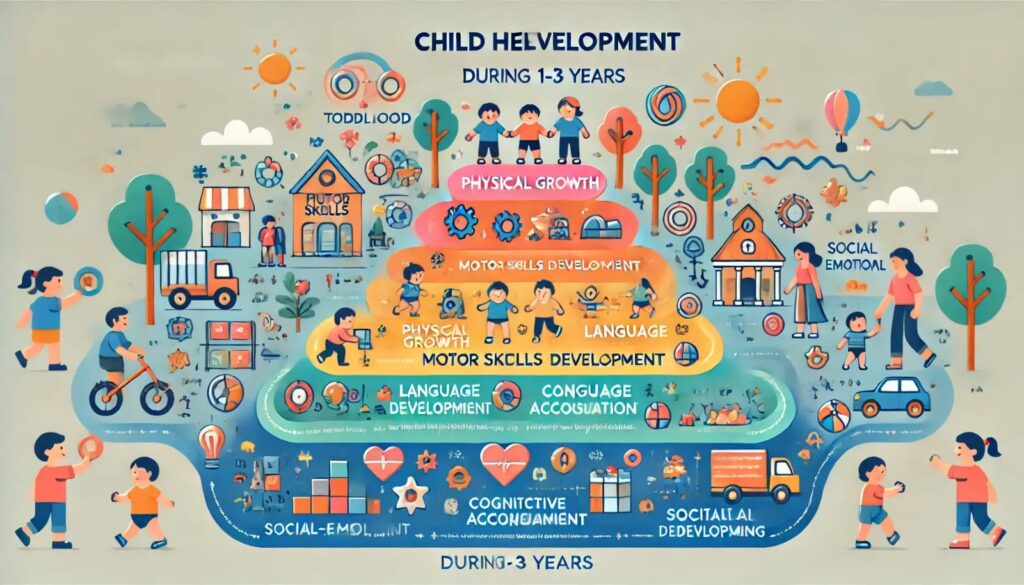
Toddlerhood (1-3 Years) in Child Health Development is a dynamic stage characterized by significant physical, cognitive, social, and emotional growth. During this period, children become increasingly mobile and begin to assert their independence, which impacts their development in various ways.
Physical Development:
Gross Motor Skills:
Toddlers refine their gross motor skills, transitioning from walking to running, jumping, and climbing. They gain better balance and coordination, allowing for more active play.
Fine Motor Skills:
They also develop fine motor skills by manipulating small objects, stacking blocks, and using utensils, which enhance hand-eye coordination.
Cognitive Development:
Language Acquisition:
This stage is marked by rapid language development. Toddlers begin to form simple sentences, expand their vocabulary, and engage in basic conversations.
Problem-Solving:
They explore their environment through play, demonstrating early problem-solving skills by figuring out how to manipulate toys and solve simple challenges.
Social Development:
Independence and Autonomy:
Toddlers often exhibit a desire for independence, wanting to do things on their own. This can lead to power struggles but is a natural part of their growth.
Peer Interaction:
Social interactions with peers become more frequent, helping toddlers learn sharing, cooperation, and conflict resolution.
Emotional Development:
Emotional Expression:
Toddlers begin to express a wider range of emotions, including frustration, joy, and anger. They may also experience separation anxiety when away from caregivers.
Attachment:
Forming secure attachments remains important, as toddlers rely on caregivers for comfort and support in navigating their feelings.
Overall, toddlerhood is a critical stage in child health development, where physical, cognitive, social, and emotional skills flourish. Moreover, caregivers play a vital role in supporting this growth by providing a safe, nurturing environment that encourages exploration and learning. Monitoring progress during this stage helps ensure that children develop the skills they need for future success.
Tip: Foster language skills by engaging in conversation, reading together, and encouraging pretend play.
Preschool Age (3-5 Years)

Preschool Age (3-5 Years) in Child Health Development is a pivotal stage characterized by significant advancements in physical, cognitive, social, and emotional growth. During these years, children transition from toddlerhood into a more independent phase of development, where they develop critical skills that will serve as the foundation for future learning and interactions.
Physical Development:
Gross Motor Skills:
Preschoolers refine their gross motor skills, becoming more coordinated and agile. They can run, jump, climb, and kick a ball with increased confidence. Activities such as dancing and playing sports enhance their physical abilities.
Fine Motor Skills:
Fine motor skills improve significantly as children learn to manipulate small objects, draw, cut with scissors, and use utensils effectively. These skills are essential for tasks like writing and self-care.
Cognitive Development:
Language Skills:
Vocabulary expands rapidly during this stage, with preschoolers beginning to form more complex sentences. They engage in storytelling and conversations, enhancing their communication skills.
Thinking and Problem-Solving:
Preschoolers develop critical thinking and problem-solving abilities. They begin to understand concepts such as numbers, shapes, and colors, and engage in imaginative play, which fosters creativity and cognitive flexibility.
Social Development:
Peer Interaction:
Social skills blossom as children interact with peers, learning to share, cooperate, and resolve conflicts. Play becomes more complex and collaborative, facilitating friendships and social networks.
Understanding Rules:
Preschoolers begin to grasp social rules and norms, understanding concepts like taking turns and following instructions. This understanding lays the groundwork for more structured environments, such as schools.
Emotional Development:
Emotional Awareness:
Children become more aware of their emotions and those of others. They learn to express feelings verbally and through play, which helps in developing empathy and emotional intelligence.
Independence:
Preschoolers assert their independence, often expressing a desire to do things on their own. This drive for autonomy can lead to both positive growth and occasional challenges as they navigate limits and expectations.
The preschool age (3-5 years) is a crucial period in child health development, marked by significant growth across physical, cognitive, social, and emotional domains. Caregivers and educators play an essential role in fostering this development by providing a supportive and engaging environment that encourages exploration, learning, and positive interactions. Monitoring progress during this stage helps ensure that children are developing the skills necessary for success in school and life.
Tip: Provide opportunities for group play and structured activities to enhance social interactions.
Early Childhood (5-7 Years)
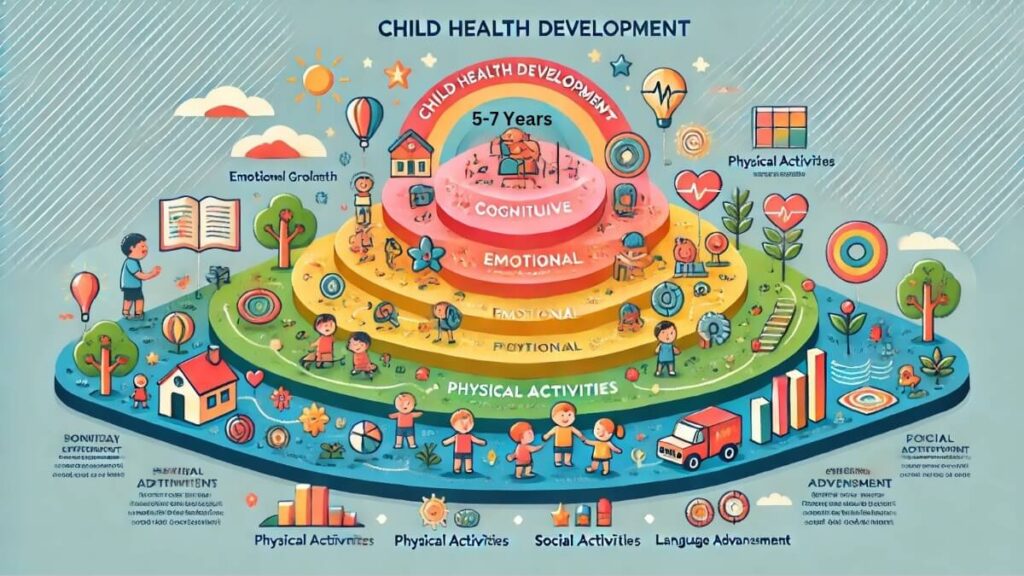
Early Childhood (5-7 Years) in Child Health Development represents a vital stage in a child’s growth, where significant changes occur across physical, cognitive, social, and emotional domains. This period is marked by the transition into formal schooling, which plays a critical role in shaping a child’s development.
Physical Development:
Growth Patterns:
Children experience steady growth, with an average increase in height and weight. They typically gain about 4-7 pounds and grow 2-3 inches each year.
Motor Skills:
Fine and gross motor skills continue to be refined. Children develop greater coordination, allowing them to participate in sports, ride bicycles, and engage in more complex physical activities like dance or gymnastics. Fine motor skills improve as they learn to write, draw, and complete puzzles.
Cognitive Development:
Language Skills:
Vocabulary expands significantly, with children learning to use more complex sentences. They also develop skills in reading and writing, often beginning to read simple texts independently.
Problem-Solving and Critical Thinking:
Cognitive abilities advance as children begin to think logically and critically. They can categorize objects, understand basic mathematical concepts, and solve simple problems, which are enhanced through school experiences and structured play.
Social Development:
Peer Relationships:
Friendships become increasingly important during this stage. Children learn to navigate social dynamics, including cooperation, negotiation, and conflict resolution, which fosters their social skills.
Understanding Rules and Cooperation:
They begin to understand and appreciate rules in games and social interactions. This understanding helps them engage in group activities and follow directions, fostering teamwork.
Emotional Development:
Self-Regulation:
Children develop better emotional regulation skills, learning to express their feelings more appropriately and manage frustrations. They begin to understand the importance of empathy and the feelings of others.
Independence and Self-Identity:
This period is crucial for developing a sense of self and independence. Children explore their interests and abilities, which contributes to their self-esteem and confidence.
Early childhood (5-7 years) is a critical stage in child health development, marked by substantial growth in physical, cognitive, social, and emotional areas. Caregivers and educators play an essential role in supporting this development by providing nurturing environments that encourage exploration, learning, and positive relationships. Monitoring progress during this stage ensures that children are well-equipped for the challenges of formal schooling and social interactions, laying the foundation for lifelong learning and development.
Tip: Encourage participation in group activities and sports to develop teamwork and leadership skills.
Middle Childhood (7-11 Years)

Middle Childhood (7-11 Years) in Child Health Development is a significant period marked by steady growth and substantial advancements across physical, cognitive, social, and emotional domains. This stage is critical for developing foundational skills that will influence a child’s academic and personal success.
Physical Development:
Growth Patterns:
During middle childhood, children experience steady growth, with an average height increase of 2-3 inches and a weight gain of about 5-7 pounds each year. This growth rate may vary significantly among children.
Motor Skills:
Physical abilities continue to refine, with improvements in coordination, balance, and strength. Children become more adept at participating in organized sports and complex physical activities, enhancing their gross motor skills. Fine motor skills also advance, allowing for more precise tasks like writing, drawing, and crafting.
Cognitive Development:
Thinking and Learning:
Cognitive abilities become more sophisticated. Children develop logical thinking, problem-solving skills, and critical reasoning. They begin to understand abstract concepts, such as time and money and can engage in more complex academic tasks.
Academic Skills:
This is a crucial period for literacy and numeracy development. Children typically learn to read fluently and comprehend various texts, while also developing mathematical concepts such as addition, subtraction, multiplication, and division.
Social Development:
Peer Relationships:
Friendships become increasingly important, with children forming strong bonds with peers. They learn social skills, including cooperation, empathy, and conflict resolution. Group activities and teamwork become central to social interactions.
Understanding Social Norms:
Children begin to grasp societal norms and values, which helps them navigate various social settings, from school to extracurricular activities. They learn to respect rules, understand fairness, and appreciate diverse perspectives.
Emotional Development:
Self-Esteem and Identity:
Children develop a more defined sense of self and identity, often influenced by peer feedback and academic performance. They may experience fluctuations in self-esteem, making positive reinforcement from caregivers essential.
Emotional Regulation:
Emotional regulation skills improve, enabling children to manage their feelings and reactions more effectively. They learn to express emotions appropriately, cope with stress, and handle setbacks, which fosters resilience.
Middle childhood (7-11 years) is a crucial phase in child health development, marked by steady growth and significant advancements in physical, cognitive, social, and emotional areas. Caregivers and educators play a vital role in supporting this development by providing nurturing environments that encourage exploration, learning, and positive relationships. Monitoring progress during this stage ensures that children are equipped with the skills and confidence needed for future academic challenges and social interactions, laying the groundwork for lifelong development.
Tip: Support academic growth with structured learning and encourage friendships through group activities.
Adolescence (11-18 Years)
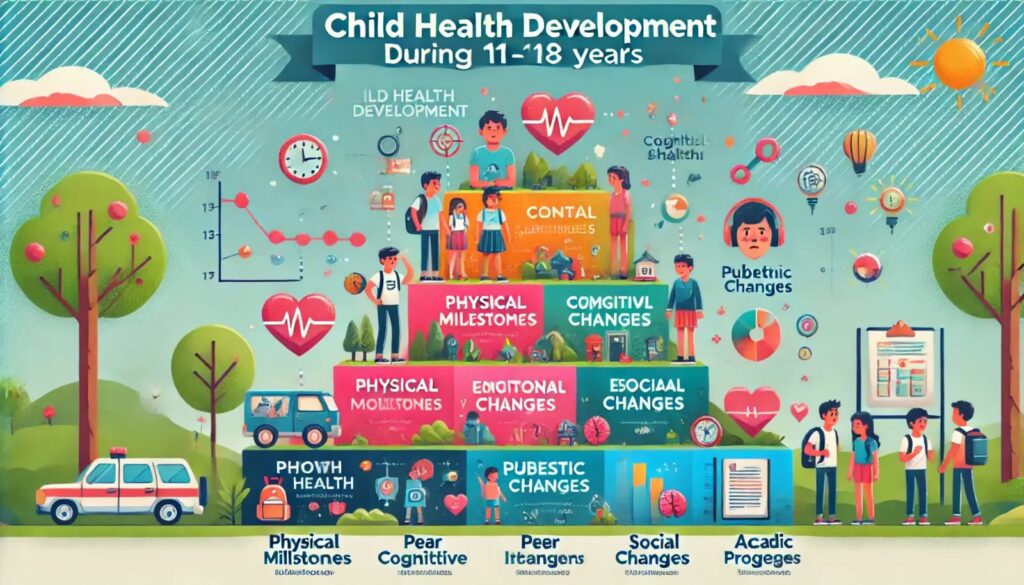
Adolescence (11-18 Years) in Child Health Development is a transformative period characterized by rapid physical, cognitive, emotional, and social changes. This stage marks the transition from childhood to adulthood and is crucial for identity formation and personal development.
Physical Development:
Growth Spurts:
Adolescents experience significant growth spurts, with girls typically beginning their growth phase earlier than boys. During this time, adolescents may gain 10-12 inches in height and undergo considerable weight changes as they develop into adult bodies.
Puberty:
Puberty brings about sexual maturation, with boys experiencing increased muscle mass and girls developing body fat and breast tissue. Hormonal changes also lead to secondary sexual characteristics, such as voice changes in boys and menstrual cycles in girls.
Cognitive Development:
Advanced Thinking Skills:
Cognitive abilities become more sophisticated as adolescents develop abstract thinking, critical reasoning, and complex problem-solving skills. They begin to think hypothetically and engage in metacognition, allowing them to reflect on their thought processes.
Decision-Making:
Adolescents improve their decision-making skills and can weigh risks and consequences more effectively. However, impulsivity can still be a factor, leading to both positive explorations and potential pitfalls.
Social Development:
Peer Influence:
Friendships become increasingly important, often influencing behaviors, interests, and identity. Adolescents seek peer acceptance and may feel pressure to conform to social norms and group expectations.
Identity Exploration:
Adolescence is a critical time for exploring personal identity, including gender roles, cultural values, and individual beliefs. This exploration can lead to a greater sense of self and autonomy as they establish their identities.
Emotional Development:
Emotional Regulation:
Adolescents work on regulating their emotions more effectively. They experience intense feelings, which can sometimes lead to mood swings and emotional volatility. Learning coping strategies and seeking support are crucial during this time.
Self-Concept:
This stage involves developing a self-concept and self-esteem based on personal achievements, social interactions, and comparisons with peers. A supportive environment helps adolescents build a positive self-image.
Adolescence (11-18 years) is a pivotal stage in child health development, marked by profound changes across physical, cognitive, social, and emotional domains. Caregivers and educators play a vital role in guiding adolescents through this transformative period by providing support, encouragement, and opportunities for exploration. Monitoring progress during this stage helps ensure that adolescents develop the skills and resilience necessary for navigating the complexities of adulthood, setting the foundation for lifelong health and well-being.
Tip: Encourage open communication and support their independence while providing guidance.
The Importance of Recognizing the Stages of Child Health Development
Recognizing the stages of child health development is essential for parents and caregivers. Firstly, understanding these stages enables effective monitoring of a child’s growth and milestones. Each stage presents unique challenges and opportunities; therefore, being aware of these developmental phases allows for early identification of potential delays or concerns. Moreover, this knowledge fosters a nurturing environment where children can thrive both emotionally and physically.
As children progress through these stages, caregivers can implement targeted strategies and activities that promote healthy development. For instance, engaging in age-appropriate play can enhance motor skills, while encouraging social interactions fosters emotional intelligence. Consequently, understanding the stages of child health development not only helps parents respond to their child’s needs but also strengthens the parent-child bond.
Acknowledging these critical stages ensures children reach their full potential, leading to lifelong well-being. By staying informed, parents can create a solid foundation for their child’s future health and happiness.
Supporting Healthy Development at Each Stage
To foster healthy development across all stages, consider the following strategies:
Promote Healthy Nutrition
Promoting healthy nutrition is essential for supporting development at each stage of a child’s growth. First and foremost, a balanced diet provides the necessary nutrients to fuel physical growth, strengthen bones, and support brain function. For instance, during early childhood, proper nutrition helps build strong muscles and bones. Furthermore, as children grow, a well-rounded diet continues to play a key role in enhancing cognitive development by improving concentration, memory, and problem-solving skills. Additionally, good nutrition boosts the immune system, ensuring overall health. Ultimately, incorporating a variety of fruits, vegetables, whole grains, and proteins contributes to long-term physical and cognitive development.
Encourage Active Play
Encouraging active play is vital for promoting a child’s overall development. To begin with, active play supports physical growth by strengthening muscles, improving coordination, and enhancing motor skills. Activities like running, jumping, and climbing help children stay fit and build endurance. Moreover, active play also benefits cognitive development by fostering problem-solving, creativity, and critical thinking as children engage in imaginative games. Socially, it encourages teamwork, communication, and sharing when playing with peers. In addition, it helps release energy and reduce stress, contributing to emotional well-being. Ultimately, active play lays the foundation for a healthy lifestyle, supporting physical, mental, and social growth.
Provide Emotional Support
Providing emotional support is crucial for a child’s well-being and overall development. First and foremost, emotional support fosters a sense of security and trust, allowing children to express their feelings openly. By offering comfort and understanding, caregivers help children build resilience and manage stress. Furthermore, consistent emotional support strengthens self-esteem, encouraging children to develop confidence in their abilities. It also nurtures healthy relationships by teaching empathy, communication, and problem-solving skills. Moreover, feeling emotionally supported enhances cognitive development as children are better able to focus and learn. Ultimately, emotional support is key to nurturing a child’s mental and emotional health.
Engage in Learning Activities
Engaging in learning activities is essential for a child’s cognitive and social development. To begin with, interactive activities like puzzles, reading, and problem-solving games stimulate brain growth and improve critical thinking skills. Additionally, learning activities enhance memory, concentration, and language development, which are crucial during early childhood. By participating in hands-on experiences, children also build fine motor skills and creativity. Furthermore, group learning activities foster social skills such as teamwork, communication, and cooperation. These activities not only make learning enjoyable but also create a foundation for lifelong curiosity and academic success. Ultimately, learning activities contribute to well-rounded intellectual and social growth.
Monitor Milestones
Monitoring milestones is crucial for tracking a child’s development and ensuring they meet important growth markers. First, it helps caregivers identify whether the child is hitting physical, cognitive, and emotional benchmarks for their age. By observing milestones like walking, talking, and problem-solving, caregivers gain insight into a child’s progress. Additionally, early detection of potential delays enables timely intervention. Furthermore, monitoring milestones sheds light on social and emotional development, allowing for better support. Ultimately, this ensures children receive guidance for balanced, healthy growth.
understanding child health development stages is vital for ensuring proper growth, leading to lifelong well-being.
The main stages of child health development include infancy, toddlerhood, preschool, school age, and adolescence. To begin with, infancy focuses on rapid physical and sensory growth. Then, toddlerhood is marked by improved motor skills and language development. As children progress, school age brings more advanced cognitive and social abilities, while adolescence is characterized by significant physical and emotional changes.
Physical milestones vary significantly across different stages. For example, infants develop basic motor skills like crawling and walking. In contrast, toddlers refine their coordination and start engaging in more complex physical activities. By the time they reach school age, children develop stronger coordination, while adolescence brings puberty and rapid physical growth.
Parents can support each stage of development by providing age-appropriate care and activities. For instance, during infancy, providing sensory stimulation and proper nutrition is essential. As children grow, encouraging active play during toddlerhood and preschool helps develop physical and cognitive skills. Moreover, offering emotional support and guidance during adolescence is crucial for managing social and emotional changes.

1 Comment
Alright alright, KU11bet looks pretty slick! About time I try my luck there. Anyone had any good wins lately? Give it a whirl at ku11bet